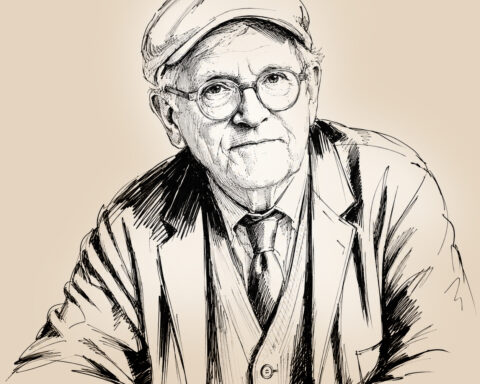
Brice Marden, whose elegant fusion of minimalism and Abstract Expressionism in the 1960s revivified painting and established him as one of the most admired and influential artists of his generation, died on Thursday at his home in Tivoli, N.Y., in Dutchess County. He was 84.
The cause was cancer, his wife, Helen Marden, said in a statement.
In the mid-1960s, when conceptual art, Pop Art and minimalist sculpture were in the ascendancy and painting was declared dead by many critics and artists, Mr. Marden issued a powerful counterstatement.
His paintings, first exhibited in New York at the Bykert Gallery in 1966, seemed irreducibly minimalist at first glance — a solid field of color for each canvas, in ambiguous gray and green tones, with an unpainted one-inch strip at the bottom where drips of paint ran over. On closer inspection, the matte surfaces, achieved through a mixture of oil paint and liquefied beeswax, opened up to reveal intricate textural layerings, applied with brush and spatula, that reflected his preoccupation with masters like Zurbarán, Goya and Cézanne and his total rejection of the impersonal aesthetic of conceptualism and minimalism.
“It seems as though, because the early paintings were just one color, one could say one color, no feelings — but instead of no feelings they were all this feeling,” Mr. Marden told Bomb magazine in 1988. “Each layer was a color, was a feeling, a feeling that related to the feeling, the color, the layer beneath it. A concentration of feelings in layers.”
The critical response was overwhelming, propelling Mr. Marden to art-world stardom while he was still in his 20s. Hilton Kramer, reviewing the Solomon R. Guggenheim Museum’s retrospective of his work in The New York Times in 1975, called Mr. Marden not simply a painter but the leader of an entire school.
“The art journals follow his work with close attention,” he wrote. “Younger painters, scarcely out of school, take his work as a model the way their counterparts once took Willem de Kooning’s and Jasper Johns’s and Frank Stella’s.”
Mr. Marden maintained this exalted status throughout his career. In his five “Grove Group” paintings of the early to middle 1970s, inspired by the olive trees he saw on his annual visits to the Greek island of Hydra, he introduced modulated greens, browns and blacks into his canvases; in the vibrant “Summer Table” (1972-73), he introduced pulsing blues and a searing yellow. “After a summer in Greece I felt the light should be intenser, clearer and less shrouded,” he wrote in 1973.