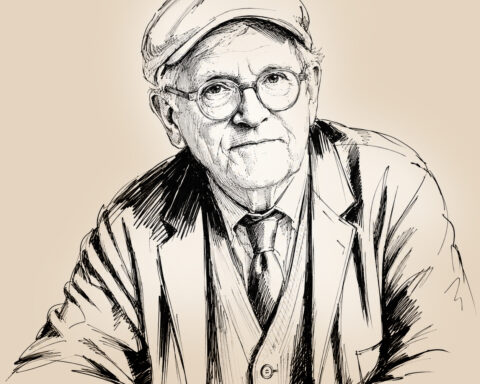
Park Seo-Bo, a painter whose elegantly furrowed monochromes and indefatigable drive made him a pillar of the Korean art world, died on Oct. 14 in Seoul. He was 91.
His son Park Seungho said the cause was cardiopulmonary arrest, adding that his father had chosen to forego treatment for lung cancer.
Park Seo-Bo was primarily known for monochromes, which he made by moving a pencil or stylus through wet oil paint in a wavelike motion; the art critic Baang Ken-Taik advised him to call the works Écritures, from the French word for writing. Mr. Park later adapted the process for Korean mulberry paper, or hanji, which he believed to be more durable.
Like most artists of his generation, Mr. Park had been trained in calligraphy and ink painting as well as in oil, but his approach in the Écritures had less in common with writing or even with conventional painting than it did with conceptual art. By distilling mark making to an essential gesture with no specific meaning, and then repeating that gesture more or less indefinitely, he turned his art practice into a kind of meditation, one that was void, in the Buddhist sense, of both content and form.
Mr. Park made it through less than a semester before civil war broke out. He was captured by the North Korean People’s Army and put to work drawing maps and painting backdrops for a propaganda theater troupe. When, a few months later, Gen. Douglas MacArthur arrived with American troops, Mr. Park escaped in the confusion — only to be impressed into South Korea’s army shortly afterward. His father died around this time.
Mr. Park was released the next year. Determined to continue his education, he found his way to Seoul, where he made money drawing extemporaneous portraits of American servicemen. Continuing on to Busan, where Hongik University had temporarily relocated, he re-enrolled as a student of western painting, studying with Kim Whanki and Lee Jong-Woo. He would sleep under the eaves of a cafe when he couldn’t find a friend to stay with.
But Mr. Park was apprehensive about being drafted again. The day before he graduated, in 1955, he adopted the given name Seo-Bo, bought a fake I.D. and fled. He grew a beard, affected a fedora and spent several months wandering the country before returning to Hongik, where he slept in a janitor’s room and painted in empty studios at night.
Several more years of struggle followed, during which he ran ad hoc private art schools, met and married a younger art student named Yoon Myungsook, worked his way through various painting styles, wrote reviews and feuded with fellow artists, all while avoiding the military police.