How did your artistic journey begin?
I started young, intrigued by magazine images of prominent New York artists. A teacher recognized my potential early, and with my family’s support, I immersed myself in various artistic forms from a very young age. I painted, drew, and even experimented with metalwork and other mediums throughout my childhood.
What was your early artistic training like?
My formal training began at the Beaumont Art Museum and continued with private lessons. It was comprehensive—I learned to handle multiple mediums, including watercolors and metalworking. By my teens, I was already doing oil portraits, discovering my love for capturing human expressions.
How did family expectations shape your path?
Growing up in the practical-minded 1950s, my family encouraged a stable career over art. While I wanted to study fine arts, I pursued English and History to become a teacher. It was a practical compromise, but it laid important groundwork that influenced my later artistic exploration.
What led you back to art after your teaching career?
Teaching was enriching yet demanding, and after several years, motherhood became an opportunity to pivot back towards art. The 1970s feminist movement and personal health challenges further inspired my return to painting. Rediscovering my passion, especially inspired by the landscapes of Big Bend, Texas, felt liberating.
What inspired your move to Santa Fe, and how did it influence your art?
Relocating to Santa Fe in the early 1980s significantly changed my artistic direction. The dramatic desert landscapes and the creative community inspired a transition toward abstract art. It allowed me to explore deeper spiritual and symbolic meanings within my work.
Describe your transition into abstract art.
Abstraction provided a deeper level of expression. Influenced by ideas from Buddhism, the I Ching, and physics, I explored themes of interconnectedness and universal harmony. It marked a major turning point, allowing me to express complex, philosophical concepts visually.
How did your husband’s passing affect your artistic practice?
After my husband, artist William Preston, passed away in 2015, I turned to long nonfiction audiobooks to fill educational gaps and satisfy my growing curiosity about the universe. Topics ranged from Buddhism and neuroscience to physics and cosmology, profoundly reshaping my perspective and inspiring my art.
How do physics and cosmology shape your current artwork?
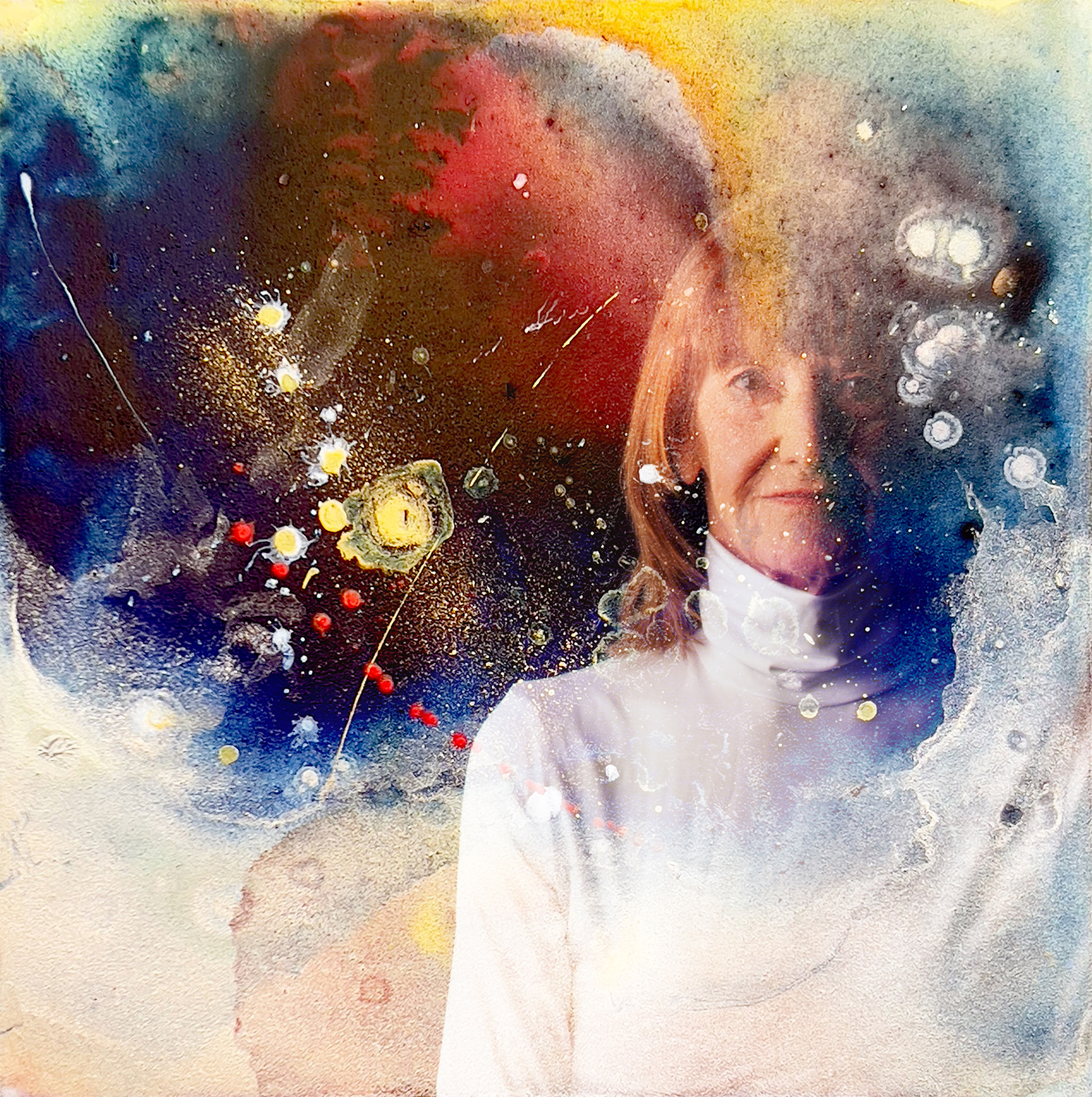
My current paintings reflect a fascination with cosmic mysteries uncovered by modern telescopes like Hubble and James Webb. Works like “Dream 5” and “Space/Time Dreams 2” illustrate this exploration. My approach has become more experimental, embracing acrylic pigments, gravity, and chance to create ethereal abstractions that suggest the vastness and complexity of space.
Can you elaborate on your experimental approach?
I now work intuitively, controlling only certain elements like color and paint viscosity. This approach, seen in pieces such as “Dream 4” and “Awe and Wonder 2,” creates unpredictable, translucent images that capture the essence of cosmic mystery and wonder.
What do you hope viewers experience when engaging with your art?
I aim for my art to evoke contemplation and curiosity about the universe’s infinite unknowns. My paintings, such as “Space/Time Dreams 5: The Multiverse,” express a fascination with discoveries that continually reshape our understanding, inviting viewers into a shared sense of wonder.
Artist Marianna Hornbuckle shares an ethereal collection of abstract paintings inspired by physics and space. View more on her website, https://www.mariannehornbuckle.com
.