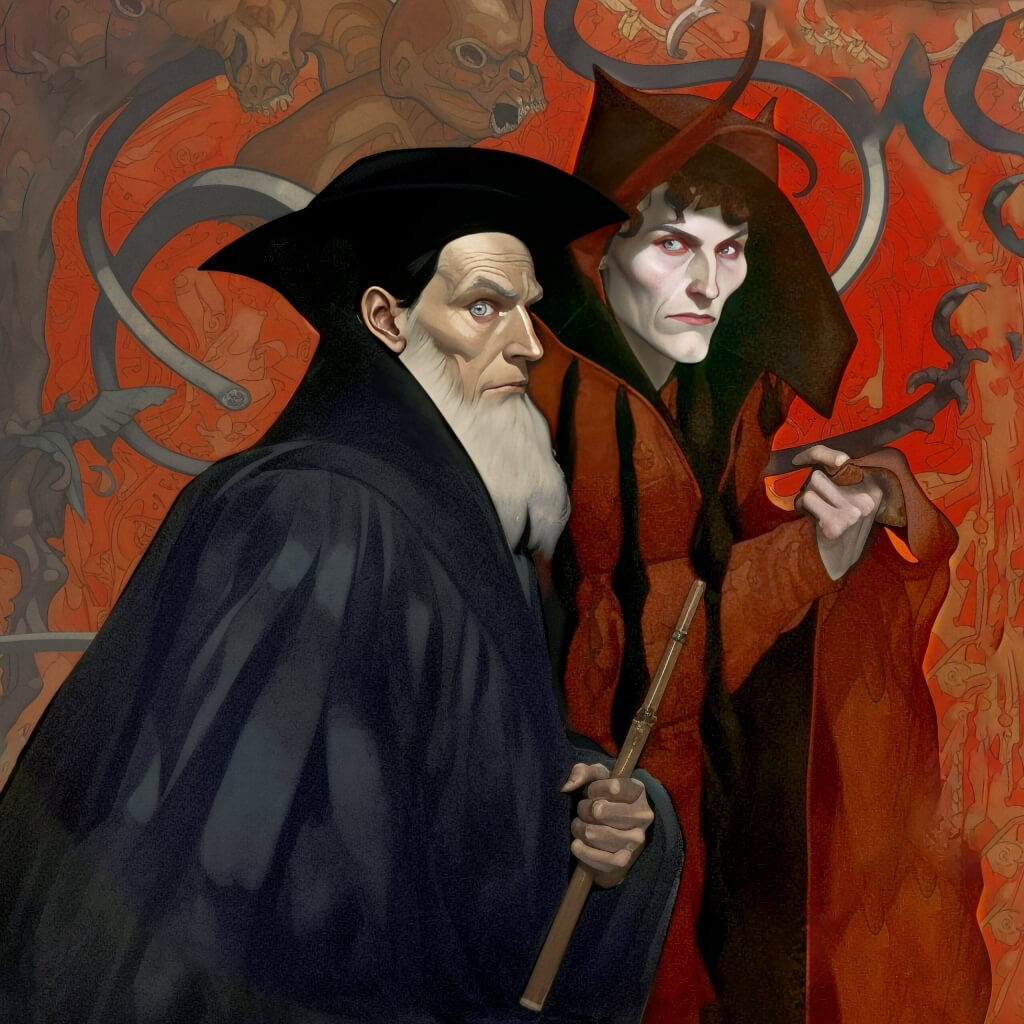
In this extraordinary work by Peter Farago, the painter brings the timeless tension between Faust and Mephistopheles into vivid and dynamic form, demonstrating his mastery over both symbolic narrative and striking visual composition. Farago, hailing from Santa Fe, NM, draws the viewer into the psychological drama of Goethe’s classic, rendering the confrontation with an acute sense of moral ambiguity and existential peril. His interpretation of Faust resonates deeply with contemporary viewers, as the story of a man bargaining with dark forces for power and knowledge reemerges as a powerful allegory for the complexities of our modern era.
An Iconic Depiction of Good and Evil
Farago’s artistic vision unfolds through the juxtaposition of Faust, portrayed as a learned but deeply troubled scholar, and Mephistopheles, the embodiment of seductive evil. The devil, rendered with a chilling elegance, is cloaked in deep, hellish reds, his gaze sharp, sly, and menacing, while Faust’s somber, introspective expression evokes a man caught in the throes of intellectual and spiritual crisis. As we find ourselves in a world increasingly shaped by the pursuit of knowledge, technology, and power, Farago’s depiction of Faust speaks to the dangers of unchecked ambition and the human cost of moral compromise.
A Color Palette of Infernal Drama
The artist’s color palette—dominated by intense reds, blacks, and ochres—calls to mind the infernal and the sublime, balancing elements of gothic horror and spiritual introspection. The swirling, nightmarish background of demonic figures, serpentine forms, and skulls adds to the sense of looming catastrophe, an ominous visual symphony that heightens the psychological stakes of the scene. Farago’s use of chiaroscuro intensifies the emotional depth of the piece, casting Faust’s face in a soft, melancholic light, while Mephistopheles emerges from the shadows with an air of triumphant malice. In today’s age of global uncertainties, ethical dilemmas, and crises of conscience, the symbolic weight of these two figures feels more relevant than ever.
Exquisite Detail and Symbolic Power
Farago’s attention to detail is exquisite—each line, each fold of fabric, each tendril of smoke in the background contributes to the overarching theme of inner turmoil and the perilous seduction of knowledge. His rendering of Mephistopheles’ gaunt, almost vampiric features is a masterclass in portraiture, evoking the malevolent allure of the devil’s promise. Faust’s expressive, furrowed brow captures the very essence of human frailty, caught between lofty ambition and moral decay. In a world grappling with the ethics of artificial intelligence, environmental destruction, and the pursuit of progress at all costs, the tension between these figures serves as a stark reminder of the moral pitfalls of our times.
A Visual Tour de Force
This painting is nothing less than a visual tour de force—a testament to Farago’s extraordinary ability to merge classical themes with a distinctly contemporary sensibility. His interpretation of Faust and Mephistopheles transcends mere illustration, instead offering a profound meditation on the eternal conflict between wisdom and temptation, light and darkness, redemption and damnation. In the context of the 21st century, Farago’s Faust reemerges as a cautionary tale, reminding us that the allure of knowledge and power often comes at an unimaginable price.
A Timeless Allegory, A Compelling Artist
In Farago’s hands, the myth of Faust is reborn as a timeless allegory, rendered with breathtaking detail and a bold, visceral energy that places this painting in the upper echelons of contemporary figurative art. For collectors, this piece represents not only a magnificent addition to any serious collection but also an opportunity to engage with a work that speaks deeply to the human condition and the perennial themes that have shaped Western thought. As our own society navigates moral and ethical crossroads, Peter Farago’s compelling narrative painting of Faust reminds us that these struggles are not new, but are instead universal and ever-present.
Farago, undoubtedly, has solidified his place as one of the most compelling narrative painters of our time—his Faust both a mirror to our age and a stark warning of what might lie ahead.